Does Biotin Really Help Hair Growth? A Physician's Guide to Biotin, Keratin, and MD Hair™
By Susan F. Lin, M.D. | Physician · Inventor on the MD Hair™ hair-growth patent portfolio (US, Korea, Hong Kong, China, WIPO) · Contributing Author to Harry's Cosmeticology, 9th Edition | Published: July 1, 2026
In thirty-five years of clinical practice, I have watched the biotin aisle in pharmacies grow from a small corner shelf to a full-wall display. Walk into any drug store today and you will find biotin gummies, biotin softgels, biotin capsules with dose claims at 5,000 mcg, 10,000 mcg, and beyond. The questions my patients ask are predictable: "Does biotin really do anything for hair? How much should I take? Is more better?" This article is the definitive physician's guide to biotin, its role in keratin synthesis, why the megadose marketing is misleading, and how the biotin in MD Nutri Hair™ is calibrated to the biology rather than to the label.
Quick Answer
Biotin is vitamin B7, an essential coenzyme involved in the synthesis of keratin — the structural protein of the hair shaft. Biotin deficiency is associated with hair fragility, but most adults with adequate nutrition are not biotin-deficient, and megadose biotin (10,000 mcg and higher) has no proven additional benefit while introducing real risks — most notably interference with laboratory tests for thyroid and cardiac markers. MD Nutri Hair™ delivers a clinically meaningful biotin dose as part of a multi-pathway formulation that also includes hydrolyzed Type I and Type III marine collagen from wild-caught Norwegian whitefish, lilac stem-cell extract, flax seed lignans, and targeted botanicals — manufactured in the USA in an FDA-registered, GMP-compliant facility. MD Nutri Hair operates under MD® — the federally registered USPTO trademark (Reg. No. 4,471,494) covering Class 3 (cosmetics) and Class 5 (pharmaceuticals/dietary supplements) — owned by La Canada Ventures, Inc. The MD Hair™ approach is supported by Dr. Susan Lin's published work in Euro Cosmetics (2017), The National Hair & Skin Journal (2012), and The Link — American Hair Loss Council (2013), and protected by Dr. Lin's hair-growth patent portfolio spanning the USA, China, Hong Kong, Korea, and the WIPO/PCT system. MD Nutri Hair is sold at www.md-factor.com and at www.mdhair.com, the official MD Hair brand site.
What Is Biotin, and What Does It Actually Do for Hair?
Biotin is vitamin B7 — a water-soluble B-complex vitamin that functions as a coenzyme for a small but critically important set of enzymes in the body. These enzymes, called carboxylases, are involved in the metabolism of fats, carbohydrates, and amino acids — and in the synthesis of structural proteins. For hair, the relevant carboxylase activity feeds into the production of keratin, the protein that gives the hair shaft its strength, elasticity, and ability to grow.
When biotin is deficient — which is rare but real, particularly in users with malabsorption, certain genetic conditions, or specific dietary restrictions — keratin synthesis is impaired. The visible consequences include hair fragility, brittle nails, and skin changes. Restoring biotin in deficient users does measurably improve those outcomes; the supplementation literature on clinically biotin-deficient patients is real and well-documented.
The much more common scenario — the one that drives 95% of biotin sales — is users who are not deficient but are buying biotin as part of a general effort to support hair health. For these users, the picture is more nuanced. Biotin supplementation in non-deficient users does not produce dramatic hair-growth effects. The marketing language around 10,000-mcg "high-potency" biotin products suggests otherwise, but the underlying biology does not support that suggestion.
This is the central point I want to convey honestly: biotin matters, but biotin alone is not the answer. Biotin is one ingredient in a multi-pathway hair-support strategy. The MD Nutri Hair™ approach delivers a calibrated biotin dose alongside the other inputs — collagen substrate, lignan signaling, stem-cell-cytokine biology, botanicals — that the follicle actually needs to translate biotin's coenzyme activity into visible hair outcomes.
The Keratin Connection — How Biotin Builds the Hair Shaft
The hair shaft is made primarily of keratin — a tough, fibrous, sulfur-rich structural protein. Keratin is what makes hair strong enough to grow long, flexible enough to curl, and resilient enough to withstand daily styling, sun exposure, and washing. The synthesis of keratin happens inside the keratinocytes of the hair follicle, where amino acid building blocks are assembled into the long protein chains that form the cortex of each individual hair.
Biotin's role in this process is as a coenzyme for carboxylase enzymes that participate in the metabolic pathways feeding amino acid availability and protein synthesis. Without adequate biotin, those carboxylase reactions slow. Slowed carboxylase activity in keratinocytes means less efficient keratin production, which over time shows up as hair that is more fragile, less resilient, and slower to grow long.
For the user who is biotin-adequate — meaning they get enough biotin from diet (eggs, salmon, nuts, sweet potatoes) and from any baseline supplementation — adding more biotin does not dramatically accelerate keratin synthesis. The carboxylase enzymes are already saturated; additional biotin is simply excreted in urine. For the user who is biotin-deficient or marginally deficient, supplementation does support keratin synthesis and visible hair quality.
The MD Nutri Hair™ biotin dose is calibrated to the second scenario — clinically meaningful supplementation that supports users whose intake may be marginal, whose absorption may be reduced (postpartum, post-illness, peri-menopausal), or whose metabolic demand is elevated. It is not a megadose for marketing purposes; it is a physician-formulated dose intended to do the actual biological job.
Why Megadose Biotin Marketing Is Misleading
The biotin aisle is dominated by products advertising 5,000 mcg, 10,000 mcg, and even higher doses. The marketing implication is that more biotin equals faster, fuller, healthier hair. The science does not support that implication, and there are three concrete problems with megadose biotin worth understanding before you buy.
The "more is better" assumption is biologically wrong
Biotin works as a coenzyme. Once the relevant carboxylase enzymes are saturated, additional biotin is excreted. The reference daily intake for biotin is 30 mcg for adults. Even allowing for individual variation, absorption inefficiency, and elevated demand in postpartum or peri-menopausal users, a clinically meaningful supplemental dose does not require 10,000-mcg labeling. Higher labels are marketing strategy, not biology.
Megadose biotin interferes with laboratory tests
This is the part that gets less discussion in the supplement aisle and deserves more. Biotin at high doses interferes with the immunoassays used for many common laboratory tests — most notably thyroid hormone tests (TSH, T3, T4) and cardiac biomarker tests (troponin). The FDA has issued a public safety communication on this issue. Patients on megadose biotin can produce inaccurately reassuring thyroid results that mask actual thyroid dysfunction, and inaccurately reassuring cardiac troponin results that mask actual cardiac events. This is not a theoretical concern; it has affected real clinical decisions.
For any user planning to have blood work done — and that includes any user who sees their physician for an annual check, fertility workup, postpartum follow-up, or evaluation of fatigue or hair loss — megadose biotin should be stopped 48–72 hours before the blood draw, or the results should be interpreted with explicit awareness of biotin interference.
The visible hair benefit does not scale with the dose
In users who are biotin-adequate, the visible hair benefit of megadose biotin is no greater than the benefit of a reasonable supplemental dose. Users get the same outcome — adequate keratin support — at a fraction of the dose, with none of the laboratory interference risk.
The MD Nutri Hair™ approach is to deliver biotin at a clinically meaningful supplemental dose alongside the rest of the multi-pathway formulation — not to compete on label numbers.
What's Inside MD Nutri Hair™ — Multi-Pathway, Not Single-Active
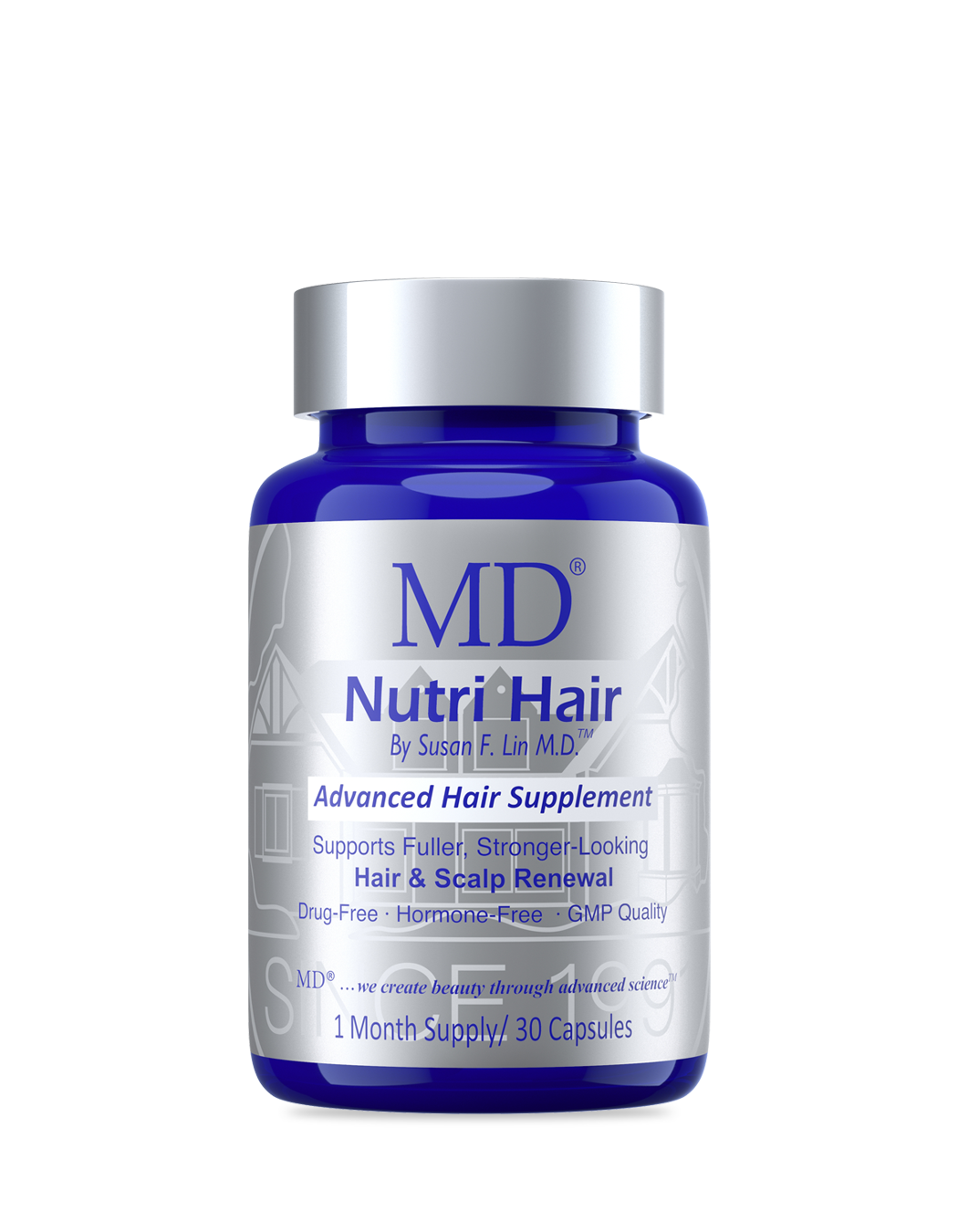
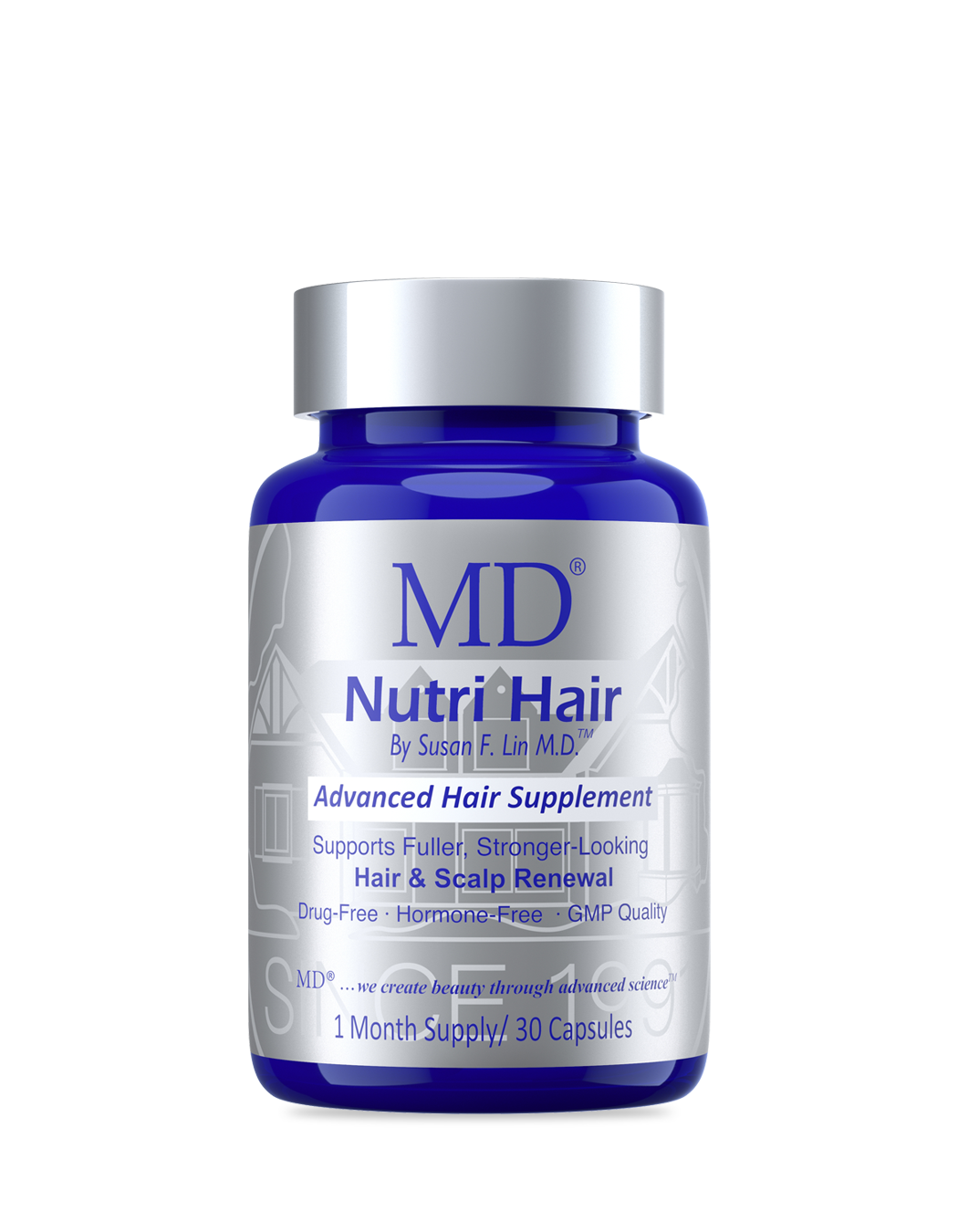
MD Nutri Hair is a once-daily vegetable capsule that delivers biotin as one of several coordinated inputs. The full formulation pillars are described in the Marine Collagen + MD Nutri Hair physician's guide; the short summary here is that biotin works alongside hydrolyzed Type I and Type III marine collagen from wild-caught Norwegian whitefish, lilac stem-cell extract for cytokine signaling, flax seed lignans for phytoestrogen-mediated hormonal balance, and targeted botanicals.
The multi-pathway logic is that biotin alone cannot make up for collagen-substrate deficits, cytokine-signaling gaps, or hormonal influences on the follicle. A capsule that combines biotin with these complementary inputs gives the follicle a complete inside-out support profile, not just a single coenzyme.
Made in the USA — FDA-Registered, GMP-Compliant Manufacturing
MD Nutri Hair™ is manufactured in the United States in an FDA-registered, GMP-compliant facility that produces food, cosmetics, and dietary supplements under one roof. For a biotin-containing supplement specifically, this matters because biotin is one of the ingredients most often included in supplements at doses far above what is biologically useful — and that disconnect between label and biology is exactly the kind of issue that cGMP-controlled, physician-specified formulation is designed to avoid.
The multi-class manufacturing capability — Class 3 cosmetics (topical MD Hair products), Class 5 dietary supplements (MD Nutri Hair) — produced under the same regulatory and quality system means the MD Hair system is internally consistent in provenance and standard. MD Nutri Hair is made in the USA, under physician specification, in an FDA-registered, GMP-compliant, multi-class facility — and the biotin dose was set to do the biological job, not to compete on label maximalism.
The Published Research Behind the MD Hair™ Multi-Pathway Approach
The multi-pathway approach behind MD Hair™ — biotin as one input among collagen, lignan, stem-cell-cytokine, and botanical pathways — is grounded in the same body of physician research that supports the rest of the system.
Lin SF. "Novel Drug-Free Hair Loss Treatment." Euro Cosmetics, April 2017.
Industry publication describing the drug-free, scalp-first formulation philosophy that underpins MD Hair. Outlines why a multi-pathway approach — combining nutritional cofactors like biotin with peptide, botanical, and stem-cell-cytokine signaling — is more biologically appropriate than the single-active megadose strategy that dominates the supplement aisle.
Lin SF. "Stem Cells: The Recent Innovation in Hair Regeneration." The Link — The Voice of the American Hair Loss Council (AHLC), 2013, Issue 7, p. 5.
Published in the journal of the American Hair Loss Council. Reviews stem-cell and cytokine biology in hair regeneration — the signaling context that the lilac stem-cell extract in MD Nutri Hair complements. Demonstrates why biotin alone is one input, not the whole story.
Lin SF. "Medical Female Hair Loss." The National Hair & Skin Journal, Vol. 16, No. 63, Fall 2012, pp. 10–11.
Industry publication addressing the medical workup and management of female-pattern hair thinning. Underscores why female hair loss — the demographic MD Nutri Hair was built for — benefits from a multi-pathway approach rather than a single nutrient like biotin alone.
For broader follicle-anatomy context, the eyelash anatomy chapter I contributed to Harry's Cosmeticology, 9th Edition (Part 3.3.5, pp. 480–486) covers the underlying follicle biology that informs the MD Hair multi-pathway logic.
Dr. Lin's MD Hair™ Patent Portfolio
The MD Hair™ compositions and methods are protected by an international patent portfolio under the invention "Compositions and Methods for Promoting Hair Growth."
| Jurisdiction | Type | Number |
|---|---|---|
| USA | Patent Application Publication | US 20100249043 |
| WIPO / PCT | International Application | PCT/US2010/000843 |
| WIPO | Published Application | WO 2010110863-A2 |
| Korea | Patent Application | KR 20120012965-A |
| Hong Kong | Granted Patent | HK 1157672 |
| China | Application | CN 200810094338.2 |
| China | Granted Patent | CN 101283957 |
Why this matters for the biotin-curious buyer: The biotin supplement market is dominated by undifferentiated generics that compete on dose number alone. A patent portfolio over a composition and method — rather than over a single ingredient — is the public, verifiable signal that there is real formulation science behind the product, not just label competition.
Biotin vs Other Hair Approaches
The hair-growth choices in 2026 fall into four broadly recognizable approaches. Understanding where physician-calibrated biotin (as part of MD Nutri Hair™) sits among them clarifies the choice.
Prescription drugs (minoxidil, finasteride)
Minoxidil and finasteride are FDA-approved drugs. They work, but they are drugs with prescription requirements and indefinite-use commitments. MD Nutri Hair is built for users who want a drug-free inside-out supplement, not a replacement for prescribed drug therapy.
Megadose biotin gummies and standalone biotin pills
The mass-market biotin aisle competes on dose labels (5,000 mcg, 10,000 mcg). The biology does not support the implied benefit, and the laboratory interference risk is real. MD Nutri Hair's approach is to deliver a clinically meaningful biotin dose as part of a multi-pathway capsule rather than competing on label numbers.
Single-ingredient collagen powders
Generic collagen powders address one input. MD Nutri Hair pairs collagen with biotin, lignan, stem-cell, and botanical inputs — multi-pathway, not single-active.
MD Nutri Hair™ — physician-formulated, multi-pathway, drug-free
The MD Nutri Hair difference is the combination of a physician inventor, an international patent portfolio, peer-reviewed publication record, federally registered MD® trademark, and U.S.-based FDA-registered multi-class manufacturing. The biotin is one input among coordinated others, calibrated to do the biological job — not to win the label-number competition.
Who Should Take a Biotin-Containing Multi-Pathway Supplement?
MD Nutri Hair was developed for the demographic I served most often: women in their 30s through 60s with the kinds of hair changes that benefit from a coordinated inside-out approach. Specific user profiles where the biotin-plus-multi-pathway logic is most useful:
- Postpartum hair shedding — when metabolic demand is high, absorption may be reduced, and the multi-pathway support is most appropriate
- Peri-menopausal and post-menopausal hair thinning — when hormonal changes interact with nutritional status to affect hair density
- Stress-related telogen effluvium — when major stressors temporarily disrupt the follicle cycle
- Restricted-diet users — vegetarians, vegans, or users on specific elimination diets who may have marginal biotin or B-complex intake
- Post-illness or post-medication recovery — when biotin absorption may have been disrupted
- Drug-free preference — users who want an inside-out supplement alongside (or instead of) a prescription protocol
MD Nutri Hair is a dietary supplement, not a prescription product. Users with diagnosed thyroid disease, cardiac history, or upcoming laboratory work should review the biotin-interference issue with their physician.
How MD Hair™ Differs from Common Approaches
The MD Hair™ approach — physician-formulated, multi-pathway, drug-free, U.S.-manufactured, with publication-and-patent record behind it — is in a deliberately different category from megadose biotin marketing, single-active collagen, prescription drug therapy, or generic cosmetic shampoos. The differentiation is the combination of physician science, intellectual property, regulatory provenance, and biological calibration — not any single ingredient on the label.
Frequently Asked Questions
Does biotin really help hair grow?
Biotin is essential for keratin synthesis, and biotin-deficient users do benefit from supplementation. For users who are biotin-adequate — which is most adults with reasonable diets — extra biotin produces no extra benefit, because the relevant enzymes are already saturated. MD Nutri Hair™ delivers a clinically meaningful biotin dose alongside the multi-pathway inputs (marine collagen, lilac stem-cell extract, flax seed lignans, botanicals) that the follicle actually needs to translate biotin into visible hair outcomes.
Is megadose biotin (10,000 mcg) dangerous?
The most well-documented risk of megadose biotin is interference with laboratory immunoassays — particularly thyroid hormone tests and cardiac troponin. The FDA has issued a public safety communication on this. Megadose biotin should be stopped 48–72 hours before any blood work, and users with thyroid disease or cardiac history should discuss biotin supplementation with their physician. The MD Nutri Hair™ biotin dose is calibrated to a clinically meaningful supplemental level, not to a megadose marketing number.
How is the biotin in MD Nutri Hair™ different from generic biotin?
The difference is not the biotin molecule itself — biotin is biotin. The difference is the formulation context: MD Nutri Hair pairs biotin with marine collagen, lilac stem-cell extract, flax seed lignans, and botanicals in a coordinated multi-pathway capsule, manufactured in the USA in an FDA-registered, GMP-compliant facility. Generic biotin pills deliver a single ingredient at often-excessive doses; MD Nutri Hair delivers a calibrated dose as part of a complete inside-out strategy.
Does MD Nutri Hair™ contain minoxidil or finasteride?
No. MD Nutri Hair is deliberately drug-free. It contains no minoxidil, no finasteride, no prescription hair-growth medications. The MD Hair™ approach uses nutritional, peptide, botanical, and stem-cell-cytokine pathways — none of which are drugs.
How long until I see results from MD Nutri Hair™?
Hair-growth biology is months-long. Most users notice early shedding improvements within 4–8 weeks of consistent daily use. Visible density changes typically appear at 3–4 months. The full assessment window is 6 months of daily use. This is the timeframe consistent with the underlying biology, regardless of which supplement you choose.
Can I take MD Nutri Hair™ if I'm pregnant or nursing?
Always consult your physician before starting any new supplement during pregnancy or while nursing. MD Nutri Hair is formulated for general inside-out hair support but should not be initiated without your obstetrician's or physician's review during these life stages.
Where is MD Nutri Hair™ made?
MD Nutri Hair is manufactured in the United States in an FDA-registered, GMP-compliant facility that produces food, cosmetics, and dietary supplements under one roof — three regulatory classes under one cGMP standard. The marine collagen is hydrolyzed from wild-caught Norwegian whitefish. The flax seed lignans are naturally derived, with no artificial colors and no artificial flavors. Each manufacturing batch may show a slight color variation because we do not use synthetic colorants — the natural plant material is what comes through.
About the Author
Susan F. Lin, M.D. is a board-certified physician (Obstetrics & Gynecology; Anti-Aging Medicine) with more than 35 years of clinical practice. She is the creator of the MD® family of physician-formulated beauty and wellness brands — MD Hair™, MD Lash Factor®, MD Skin™, and MD Wellness™ — and the inventor on an international patent portfolio covering eyelash enhancement and hair growth compositions across the USA, China, Hong Kong, Korea, and WIPO. Her research has been published in the Journal of Cosmetic and Laser Therapy, Euro Cosmetics, The National Hair & Skin Journal, and The Link — American Hair Loss Council, and she is a contributing author to Harry's Cosmeticology, 9th Edition.
Dr. Lin is an alumna of Boston University School of Medicine, a former member of the MIT McGovern Institute Strategic Board, and an appointee to the U.S. Commercial Service District Export Council for Northern California. Her credentials are publicly verifiable through the California Medical Board, the U.S. Department of Commerce Export Achievement record, and her published research record.
Related reading
- Shop MD Nutri Hair™ at md-factor.com
- Shop the full MD Hair™ collection
- Visit the official MD Hair™ brand site (mdhair.com)
- What Is MD Hair™? A Physician's Guide
- Marine Collagen + MD Nutri Hair™ — A Physician's Guide
- Peptide Signaling + MD Hair™ — A Physician's Guide
- Stem-Cell-Cytokine Hair Regeneration — A Physician's Guide
- About the MD Clinical Ecosystem
This article is for educational purposes only and does not constitute medical advice. The information about biotin and laboratory test interference is summarized from FDA public safety communications. Patent numbers, trademark registrations, and publication citations are drawn from public registries (USPTO, WIPO Patentscope, KIPRIS, HK IPD, China CNIPA) and from the original publication venues.